Between Sound and Architecture
Thirty Years of the Nova Music and Architecture Festival
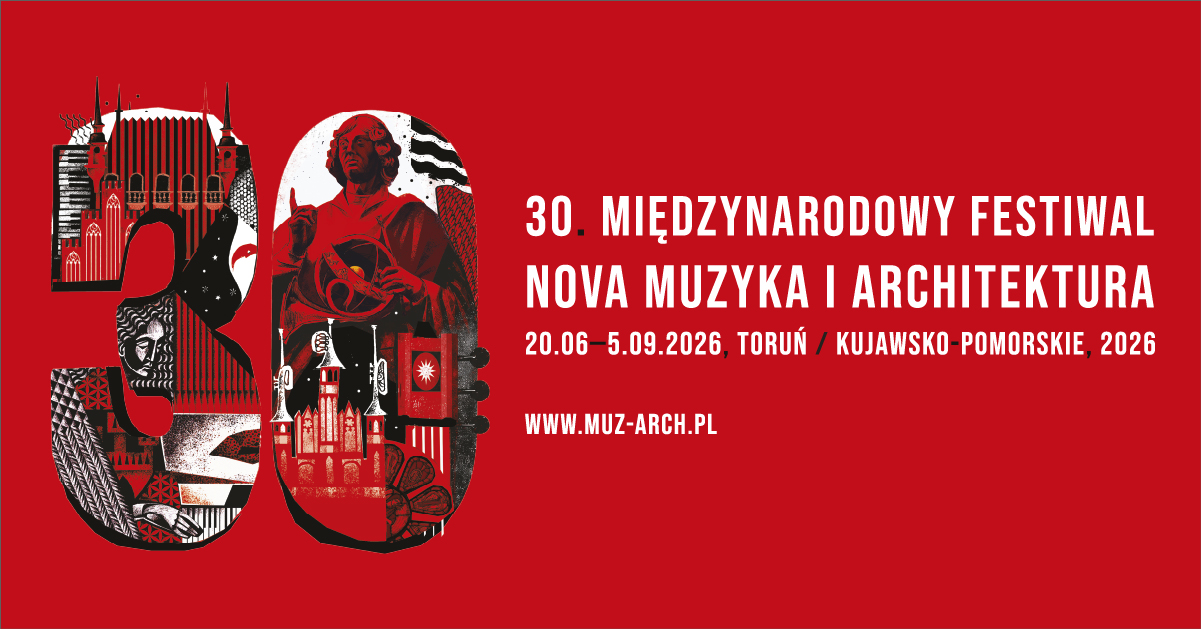
Thirty editions of the festival represent far more than an impressive number of concerts, artists, and musical events. Above all, they tell a story of people, ideas, and a place that, over the course of three decades, has created a unique space where music meets architecture, tradition encounters modernity, and local identity engages in international dialogue. The 30th anniversary of the International Nova Music and Architecture Festival therefore offers an opportunity not only for celebration, but also for reflection on the remarkable journey of one of the most important summer music festivals in northern Poland.
The festival’s history began in 1996 on the initiative of Marek Wakarecy, then director of the Toruń Chamber Orchestra – a man deeply devoted to the cultural life of the city and committed to creating artistic events of the highest quality while remaining accessible to a broad audience. From the very beginning, his closest collaborator was the distinguished conductor Professor Jerzy Salwarowski, who served as artistic director during the festival’s first editions. Their shared vision was to create an event that would bring musical life to Toruń during the summer months and allow the city’s architecture to be experienced through the art of sound.
The first concerts were held under the title Toruń – Music and Architecture, a name that perfectly captured the essence of the project. Music was intended to resonate within exceptional spaces – historic, sacred, and ceremonial – harmoniously blending with the atmosphere of a city of extraordinary cultural heritage. St Johns’ Cathedral, the Burgher Hall of the Old Town Hall, Artus Court, Palace of the Dąmbski Family, the Star Tenement, St James’s Church, the Church of the Assumption of the Blessed Virgin Mary, the Society of Arts and Sciences, and the Teutonic Castle quickly became not merely concert venues, but full-fledged protagonists of the festival itself. Over time, music also came to resonate within the walls of St Stephen’s Church, the Od Nowa student club, the Collegium Maximum of Nicolaus Copernicus University, the Władysław Dziewulski Planetarium, the Znaki Czasu Centre of Contemporary Art, Hanza Café, the Filmar Hotel, and the Copernicus Shopping and Entertainment Centre. Open-air concerts likewise became an important part of the festival programme, taking place on Philadelphia Boulevard, in the Old Town Market Square, at the amphitheatre of the Ethnographic Museum, and on the Shakespeare Stage of the Baj Pomorski Theatre. From its 20th edition onwards, the Jordanki Cultural and Congress Centre – home of the Toruń Symphony Orchestra and a symbol of the city’s contemporary architectural identity – also became one of the festival’s key venues.
From its very first editions, the festival programme has been distinguished by its remarkable diversity. Alongside early and classical music, audiences have enjoyed organ concerts, chamber recitals, Orthodox sacred music, contemporary compositions, as well as jazz, gospel, film music, folk music, musicals, and lighter repertoire. The inaugural edition featured performances by Paweł Skałuba, Roman Perucki, the Oktoich ensemble, and a staging of Pergolesi’s opera La Serva Padrona. In the years that followed, the festival steadily expanded both its repertoire and its artistic scope.
Outstanding soloists and ensembles from Poland and around the world have appeared on Toruń’s festival stages. Audiences have had the opportunity to hear artists such as Kevin Kenner, Krzysztof Jakowicz, Andrzej Bauer, Piotr Pławner, Konstanty Andrzej Kulka, Eugène Indjic, Marcin Zdunik, Urszula Dudziak, Anna Maria Staśkiewicz, Iwona Hossa, and Karen Slack, as well as the Polish Radio Chamber Orchestra “Amadeus” under the direction of Agnieszka Duczmal. Over the years, the festival has welcomed performers from Europe, Asia, Australia, and the Americas, gradually establishing itself as a truly international cultural event.
At the same time, the Nova Music and Architecture Festival has remained, from its very inception, deeply connected to the local community. Artists associated with Toruń and the surrounding region have regularly appeared on the festival’s stages, including the Toruń String Quartet, the Toruń Brass Quintet, and the Multicamerata ensemble. As a result, the festival has become not only a meeting place for internationally acclaimed artists, but also an important platform for promoting local talent and strengthening the city’s musical identity.
Educational activities have likewise played a significant role in the festival’s development. Already in its early years, concerts under the title “Youth Forum” were organised, alongside summer conducting courses led by Professor Jerzy Salwarowski. Over time, concerts by participants of the Paderewski Piano Academy became a regular feature of the programme, during which Toruń audiences were able to witness the birth of international piano careers.
In the years that followed, the festival also developed in terms of organisation and programming thanks to the commitment of successive directors and musical figures. Following Marek Wakarecy, Paweł Dudzik took over as director of the Toruń Symphony Orchestra and organiser of the festival, continuing the vision of an open, modern musical event whilst expanding its scale and international character. Piotr Sułkowski also played an important role in the festival’s history, serving as artistic director of the anniversary edition of ‘Europe – Toruń. Music and Architecture’. In 2017, the then directors of the TOS, Marek Czekała and Mariusz Smolij – a conductor associated with the greatest stages in Europe and the United States – gave the festival the scope of major international symphonic projects.
Since 2019, Dainius Pavilionis has served as the festival’s artistic director, consistently developing the concept of repertoire diversity and international cultural dialogue. It was under his baton in 2023 that one of the most moving concerts of recent years took place: the monumental music of Karl Jenkins, which drew a huge audience and remained long in the memory of festival-goers. In the same year, Przemysław Kempiński became Director of the Toruń Symphony Orchestra, continuing the institution’s tradition of openness to ambitious artistic projects, international collaboration, and the further development of the festival as one of the region’s most important musical events.
Accessibility has always remained one of the festival’s defining features. Many concerts were – and continue to be – open to the public, enabling the event to attract a remarkably broad audience from the very beginning: residents of Toruń, tourists, dedicated music enthusiasts, and also those encountering classical music for the first time. This spirit of openness and community through music was one of Marek Wakarecy’s central ideas. The festival was conceived as a celebration of both the city and its inhabitants.
Today, the Nova Music and Architecture Festival has evolved into a multifaceted cultural event. Alongside classical recitals and symphonic concerts, the programme now includes film projects, open-air performances, jazz and gospel concerts, musical productions, family events, national-themed evenings, guided tours, and multimedia presentations. Over the years, the festival repertoire has embraced the works of Bach, Mozart, Brahms, and Szymanowski, alongside compositions by Penderecki, Górecki, Lutosławski, Kilar, and Kisielewski. The festival continues to be a place where tradition encounters modernity, and where local history enters into dialogue with international culture.
This year’s anniversary carries an additional and particularly poignant dimension. In 2026, fifteen years will have passed since the tragic death of Marek Wakarecy – the festival’s founder and a figure without whom it is difficult to imagine the contemporary musical life of Toruń. He was not only an outstanding organiser and cultural manager, but above all a man of vision, passion, and extraordinary ability to bring people together through art. It was thanks to his determination and imagination that an event was created which, over the course of three decades, has become an integral part of the city’s cultural identity.
Today, thirty years later, we can proudly say that the idea conceived in the mid-1990s has not only stood the test of time, but has grown into one of the most important musical events in the region. The festival continues to serve as a meeting place for artists and audiences alike, a space for dialogue between cultures and generations, and living proof that music can endow architecture with new meaning while giving the city a unique and extraordinary atmosphere.
The celebration of the festival’s 30th anniversary is therefore not only an opportunity to reflect on its rich history, but also a moment to express gratitude to all those who have shaped its distinctive character over the years: the artists, organisers, partners, and loyal audiences. For Nova Music and Architecture is more than simply a festival. It is a collection of memories, emotions, and people – all of whom have contributed to shaping its unique spirit over the past thirty years.
Magdalena Cynk